Class Material
Econometric Methods & Causal Inference
Economics 588 at Brigham Young University
Course Overview
This course covers advanced econometric methods for causal inference and estimation. We begin with the foundations of linear regression, explore identification and estimation strategies through the lens of generalized method of moments, and develop expertise in both parametric and nonparametric approaches to empirical analysis. The course emphasizes both the theoretical foundations and practical implementation of econometric estimators.
Core Topics
OLS & Linear Regression
The foundation of econometric estimation. We develop the normal equations, understand the Gauss-Markov theorem characterizing OLS as the best linear unbiased estimator, and explore asymptotic properties including consistency and asymptotic normality.
- The OLS estimator and normal equations
- Gauss-Markov theorem and efficiency
- Consistency and asymptotic normality
- Fixed effects and panel data models
Inference & Hypothesis Testing
Methods for drawing conclusions about parameters from sample estimates. We develop both classical and asymptotic inference frameworks, including the Wald test for general linear hypotheses and calculation of standard errors and confidence intervals.
- Asymptotic distributions and standard errors
- Wald tests for linear restrictions
- Confidence intervals and p-values
- Heteroskedasticity-robust inference
Generalized Method of Moments
A unified framework for estimation based on population moment conditions. We develop the theory of GMM estimators, including identification requirements, consistency, asymptotic normality, and overidentification tests for models with more moment conditions than parameters.
- Moment conditions and identification
- GMM estimation and weighting matrices
- Consistency and asymptotic normality
- Overidentification tests
Instrumental Variables & 2SLS
Methods for estimating causal effects when regressors are endogenous. We develop the theory of instrumental variables, covering identification assumptions, the two-stage least squares estimator, the relationship between IV and GMM, and just-identified versus over-identified models.
- Endogeneity and the exclusion restriction
- Relevance and rank conditions
- Two-stage least squares (2SLS) estimation
- Just-identified and over-identified models
Extremum Estimation
General principles for estimation by maximizing (or minimizing) a criterion function. We develop consistency and asymptotic normality results for M-estimators, which encompass both GMM and other optimization-based estimators used throughout econometrics.
- Criterion functions and identification
- Consistency of extremum estimators
- Asymptotic normality and standard errors
- First-order and second-order conditions
Maximum Likelihood Estimation
Estimation based on the joint probability distribution of the data. We develop MLE theory, establish that MLEs are consistent and asymptotically normal, achieve the Cramér-Rao lower bound (asymptotic efficiency), and apply MLE to discrete choice models like logit and probit.
- Likelihood functions and MLE
- Properties of MLE (consistency, efficiency)
- Binary dependent variables (probit, logit)
- Marginal effects in nonlinear models
Censored Data & Tobit Models
Methods for handling data where the dependent variable is censored or truncated. We develop the Tobit model using MLE, understand how OLS is biased toward zero under censoring, and discuss alternative estimation strategies.
- Censoring in dependent variables
- OLS bias under censoring
- Tobit MLE estimation
- Practical implementation challenges
Quantile Regression
Estimation of conditional quantiles rather than conditional means. Quantile regression is robust to outliers and reveals heterogeneous treatment effects across the distribution. We develop asymptotic theory and inference methods for comparing different quantiles.
- Quantile functions and check loss
- Quantile regression estimator
- Consistency and asymptotic normality
- Inference across multiple quantiles
Delta Method
A technique for inference on nonlinear transformations of parameters. The delta method allows us to construct confidence intervals and conduct hypothesis tests on derived quantities like elasticities, predicted values, or any smooth function of estimated parameters.
- Taylor expansions and linearization
- Jacobian matrices
- Inference for nonlinear functions
- Predicted values and marginal effects
Kernel Density Estimation
Nonparametric methods for estimating probability distributions without assuming a specific functional form. We develop kernel density estimators, discuss bandwidth selection, and explore various kernel functions used for density and conditional mean estimation.
- Kernel functions and bandwidth
- Bias-variance tradeoff in density estimation
- Bandwidth selection methods
- Applications to conditional density
Nonparametric Regression Methods
Estimation of conditional means without specifying a functional form. We explore series regression (polynomial and spline bases), local polynomial regression, and bandwidth selection using the bias-variance tradeoff to estimate smooth functions of data.
- Series regression (polynomial and splines)
- Local polynomial regression
- Bandwidth and smoothing parameter selection
- Bias-variance tradeoff in regression
Regression Discontinuity Design
Causal inference method exploiting discontinuities in treatment assignment. RDD identifies local treatment effects at assignment thresholds without assuming unconfoundedness. We develop sharp and fuzzy designs, discuss bandwidth selection, and cover local polynomial estimation near the cutoff.
- Sharp and fuzzy RD designs
- Running variable and treatment assignment
- Local treatment effects at threshold
- Local polynomial specification
Econometrics Family Tree
How estimation methods relate to one another through the extremum estimation framework
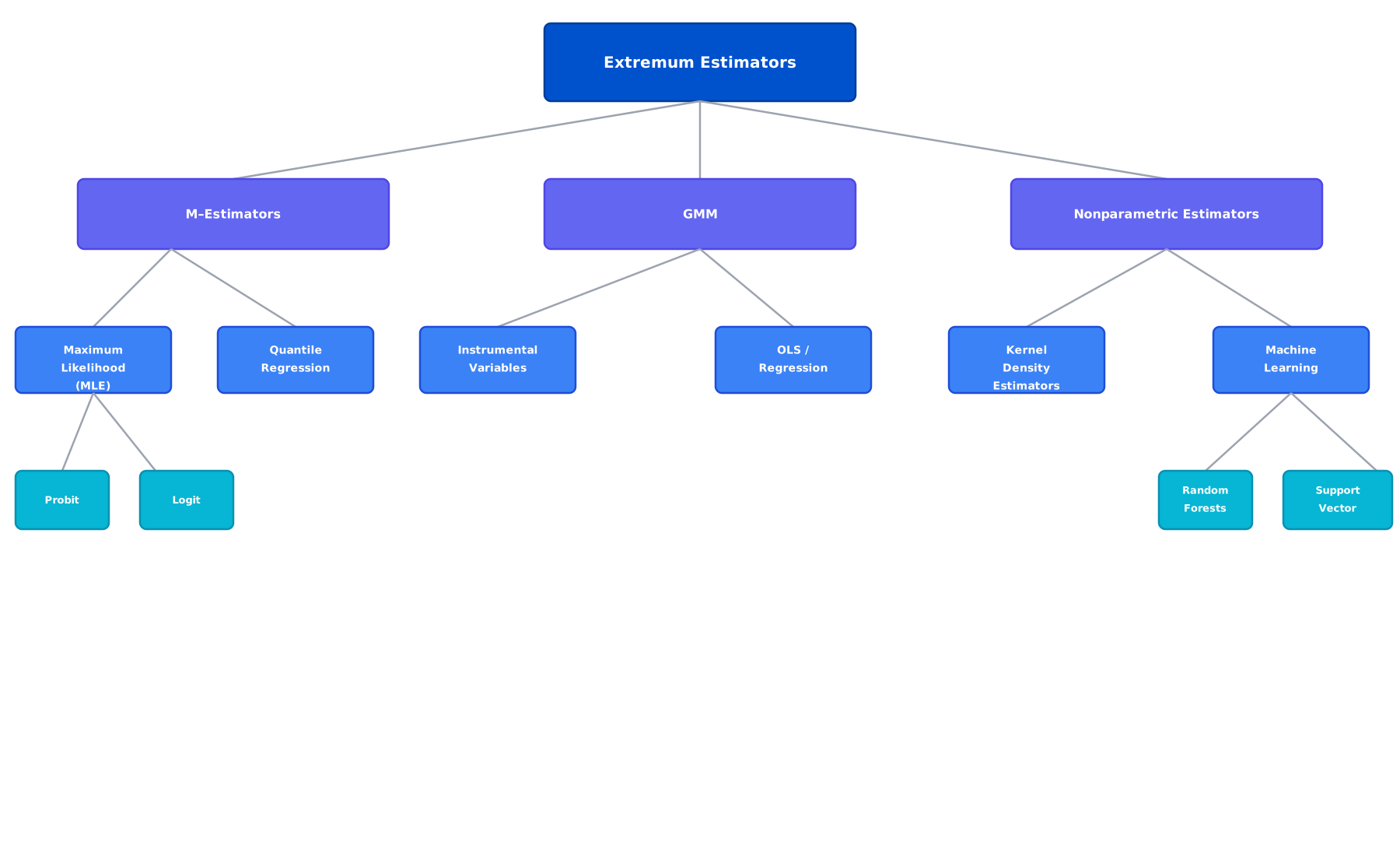
All estimators in this course can be understood through the extremum estimation framework. OLS, maximum likelihood, IV, and quantile regression all minimize (or maximize) criterion functions. The choice of criterion function and identifying assumptions determines which estimator to use and when it will be consistent and efficient.
The Econometric Process
Every econometric analysis follows these six steps. Understanding each step deeply will guide you through any empirical analysis.
Question
Start with a well-defined research question that asks about causal effects or relationships. Examples: "What is the effect of minimum wage on employment?" or "How does education affect earnings?" Your question should guide all subsequent choices about what to model, what data to use, and how to interpret results.
Model
Translate your research question into a statistical model. Define your outcome variable Y, your explanatory variables X, and your parameters of interest β. State your identifying assumptions explicitly. What assumptions do you need for consistency? Unbiasedness? Efficiency? Examples: zero conditional mean for OLS, exclusion restriction for IV, no censoring bias for nonlinear models.
Data
Collect or access data containing measurements of your outcome, explanatory variables, and any instruments or controls. Examine the data for missing values, outliers, coding errors, and whether observations are really independent. Ensure your data matches the conceptual framework of your model. Different data structures (cross-sectional, time-series, panel) require different estimators.
Estimation
Select the appropriate estimation method based on your model and data. OLS works when the zero conditional mean assumption holds. Use IV/2SLS when you have endogeneity and valid instruments. Use MLE for discrete choice models, Tobit for censored data, quantile regression for robustness, nonparametric methods when functional form is unknown, or RDD when treatment is assigned by threshold. Refer to the econometrics family tree to understand how methods relate.
Inference
Calculate standard errors, construct confidence intervals, and perform hypothesis tests on your estimates. Use heteroskedasticity-robust standard errors when appropriate. Report effect sizes alongside p-values. Test your identifying assumptions when possible (overidentification tests for IV, conditional independence tests for matching). Report sensitivity to assumption violations. Remember that asymptotics may not apply in finite samples, particularly for weak instruments or small sample sizes.
Communication of Results
Present findings to your audience—economists, policymakers, or the general public. Create tables showing coefficients and standard errors across specifications. Use figures to show magnitudes, nonlinearities, or heterogeneity. Clearly state your identifying assumptions and discuss threats to validity. Explain what your estimates mean economically, not just statistically. Avoid over-claiming causality. Discuss limitations and alternative interpretations.